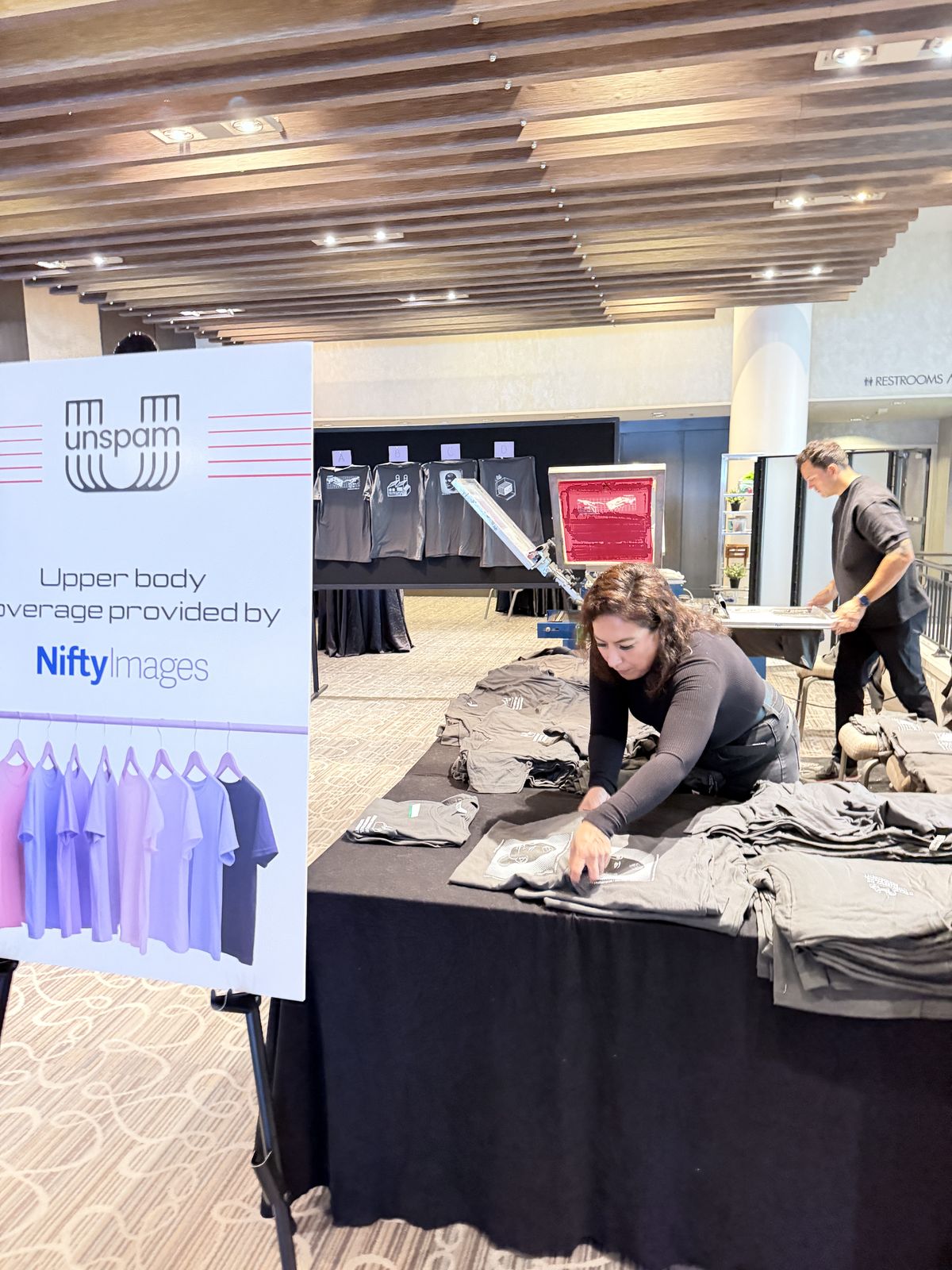
Embroidery is the slowest decoration method you can put in front of a crowd, and that is precisely why people stand there watching it. It is also why one number — how many heads you put on the floor — decides whether the activation reads as a gift or as a queue. Getting the live embroidery machine count for your event guest volume right takes about five minutes of arithmetic, and it is worth doing before anyone sends you a quote.
Work it in this order: minutes per piece, then realistic demand, then the queue system that lets you buy fewer machines than the raw math suggests.
Start with minutes, not guests
A single embroidery head runs roughly 6 to 12 minutes per piece. The spread is almost entirely stitch count and colour changes. Then add handling — hooping the garment, trimming jump stitches, folding and handing it over — which is another 45 to 90 seconds even with a sharp operator.
So plan on 5 to 9 finished pieces per head per hour. Use the low end when you are quoting yourself, because the high end assumes nothing goes wrong and nothing ever goes entirely right at an event.
Two heads across a four-hour window is therefore about 40 to 70 pieces. Four heads is 80 to 140. Notice how quickly that number stops scaling with your guest list — a 400-person gala cannot be served by embroidery alone at any sane machine count.
Not everyone will want one
The second number is participation, and it varies more than planners expect:
- Seated corporate dinner where the embroidered item is the gift: 70–90 percent. Everyone wants theirs, and they all want it at the same two moments.
- Wedding, birthday or private party: 50–70 percent, spread more evenly across the night.
- Trade show booth or festival: demand is effectively unlimited. You are not sizing to the crowd, you are sizing to how long you want the line to be.
Run the example. 150 guests at a 60 percent take rate is 90 pieces. Over a four-hour window that is about 23 pieces an hour, which needs three to four heads. That is a real budget conversation, and it is the reason our 150-guest budget breakdown lands where it does.
Shorten the design before you add a machine
Machine count is the expensive lever. Design is the free one.
A three-inch left-chest monogram or a simple two-colour wordmark sits in the fast half of the range. A detailed multi-colour crest, a large back logo, or anything with heavy fill can double or triple the same run. Small text is worse than it looks — letters under about a quarter inch tall need dense stitching to stay legible.
Practical rules that buy back real minutes:
- Cap colours at three. Every colour change is a stop, a thread swap and a re-start.
- Offer two to four preset designs plus a personalisation field — initials, a first name, a date — rather than open-ended freeform. Presets also mean digitising is done and tested before the truck loads.
- Choose the garment placement in advance. Left chest and cap front hoop quickly. Sleeves and robe backs do not.
Trimming a design from 9 minutes to 6 is the same as adding a third machine to a two-head setup, and it costs nothing on event day.
Decouple the guest from the machine
The biggest capacity gain is not hardware. It is refusing to make people stand and watch their own piece stitch out.
Run a drop-off model. The guest picks a garment and a design, an attendant tags it with a numbered ticket, and the guest gets a text or a pickup window and goes back to the party. A separate claim table hands finished pieces back. That single change lets a two-head station serve a crowd that would visibly overwhelm it under a watch-and-wait model, because the perceived wait drops to zero.
Two supporting details: publish a hard last-order time about 45 minutes before your run window ends, and keep one machine visible and unhurried at the front so people still get the show. The theatre is most of why you booked embroidery in the first place.
When to stop adding heads
Here is the honest limit. Once your required throughput passes roughly 25 pieces an hour, adding embroidery heads gets inefficient — each one brings another operator, another circuit, another table and another line item, and a staffed local package already starts around $5,000 before you begin stacking.
At that point the better build is a hybrid. Keep two embroidery heads as the premium, slow, photogenic lane for hats or a signature item, and put the volume on a second method: a hat and patch press moves 30–45 hats an hour, and a DTF and heat press station finishes 60–90 pieces an hour. Guests self-select, and the embroidery lane stays special instead of becoming the bottleneck everyone resents. If you are weighing that split on cost alone, the hat bar versus embroidery bar comparison puts the two side by side, and the pricing page shows how added heads and added hours stack.
Frequently asked questions
How many pieces can one embroidery machine finish in an hour?
Plan on five to nine, based on 6 to 12 minutes of stitch time plus handling. A small left-chest monogram sits at the fast end and a dense multi-colour back design sits at the slow end. Quote yourself using the low number so a busy hour does not become a visible failure.
Is it better to add machines or shorten the design?
Shorten the design first, every time. Cutting stitch count and colour changes is free and can lift throughput by a third or more, while another head adds an operator, a circuit and real cost. Add machines only once the design is already lean and the demand math still does not close.
What if more guests turn up than we planned for?
Switch to drop-off and pickup so nobody is standing at the machine, announce a last-order cutoff early rather than late, and have a simple second option ready such as a pressed patch or a pre-embroidered item. Post-event fulfilment for the overflow is also fair game if you collect names and sizes on the night.
Tell us the guest count
Send us your headcount, run window and the item you want stitched, and we will come back with a machine count and the piece math behind it rather than a vague promise. Read the full cost breakdown first if you want to see how the line items add up. Call (562) 614-4800 or get in touch.
How Many Embroidery Machines Does Your Guest Count Need?
Minutes per piece, realistic take rates and the queue trick that lets two heads serve a crowd sized for four.